
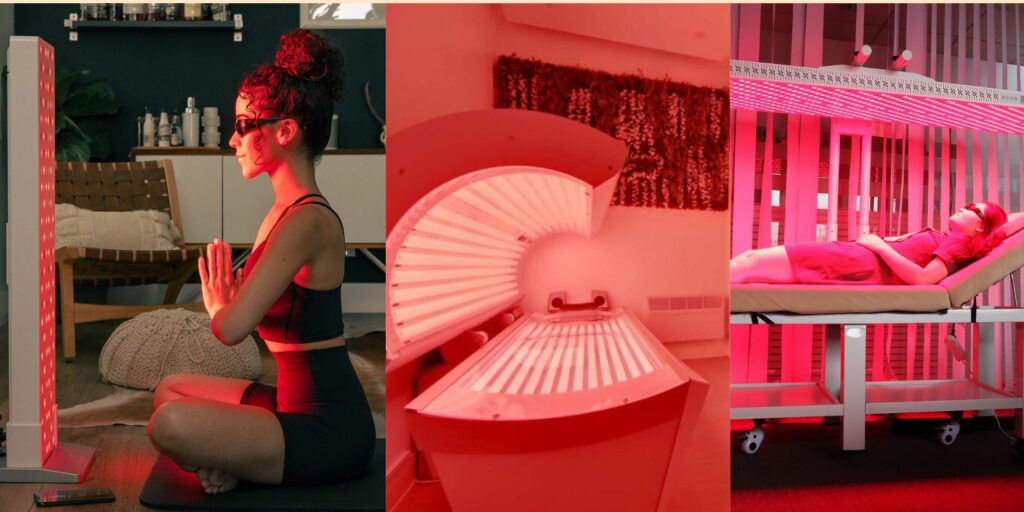
Red light therapy is no longer reserved for luxury spas or clinical recovery centres. Thanks to compact, professional-grade LED panels that require no medical licensing, no specialist staff, and as little as 1.5 m² of space, a growing number of businesses are quietly adding it to their service menu — and seeing a return on investment in weeks rather than years. This article breaks down 10 business types that are perfectly positioned to offer RLT today, with the science, the operational logic, and the revenue potential behind each one.
What Is Red Light Therapy and Why Does It Work for Any Business?
Red light therapy (RLT), also called photobiomodulation (PBM), uses specific wavelengths of red and near-infrared light — typically between 630 nm and 1060 nm — to stimulate cellular energy production at the mitochondrial level. When photons in this range are absorbed by the enzyme cytochrome c oxidase (Complex IV) in the cell’s mitochondria, they trigger an increase in ATP synthesis, a reduction in oxidative stress, and an improvement in local circulation through nitric oxide signaling.
The practical result for a business owner: clients feel better, recover faster, and look better — after sessions as short as 10–15 minutes, with no therapist needed, no consumables used, and no ongoing overhead beyond electricity.
| Key business advantage: A professional ZenGlow panel operates at >100 mW/cm² irradiance, delivering a clinically meaningful dose (10–50 J/cm²) in a 10–20 minute session. This maps directly onto the gaps in most service menus — appointment waiting time, treatment pauses, and post-service downtime. |
10 Businesses That Should Be Offering Red Light Therapy Right Now
1. Hair Salons — Turn dead chair time into a glowing upsell
Why it works: When a client is sitting under a dryer or waiting for color to develop, that idle time is a missed opportunity. A compact RLT panel positioned in front of the face can deliver a full 10–15 minute session — improving scalp circulation, stimulating follicle activity, and giving the client a visible skin glow — without adding a single minute to the appointment.
The science: Red light at 630–660 nm stimulates fibroblasts in the dermis, boosting collagen and elastin production. At the scalp level, near-infrared wavelengths improve microcirculation around hair follicles, which is the same mechanism used in clinical studies on hair regrowth.
How to run it: One compact panel. No therapist required. Add a “Glow Boost” to your service menu at 150–300 THB. Zero extra time.
Recommended device: ZenGlow PRO 60 W7 or GoldWave Mask
| 💡 ROI snapshot: At 20 clients per day, a 200 THB add-on generates 4,000 THB daily — enough to recover device cost in weeks. |
2. Nail Bars — 10 minutes of light while nails dry = a premium upsell that costs nothing extra
Why it works: Nail clients are the ideal captive audience. While polish or gel cures, a face-targeted RLT session runs simultaneously — adding genuine skin value to an otherwise static wait. Beauty-conscious clients who care about their nails almost always care about their skin too.
The science: A 10-minute session at 20 mW/cm² delivers approximately 12 J/cm² of energy to the skin — well within the optimal therapeutic window of 3–50 J/cm² documented in clinical literature.
How to run it: Position a compact panel or mask-style device at the manicure station. No operator involvement during the session. Charge as a facial add-on.
Recommended device: ZenGlow GoldWave Mask (352 LEDs)
| 💡 ROI snapshot: A mask-style device charges itself back in days when positioned as a 200–400 THB add-on at a busy nail bar. |
3. Barbershops — Modern men want more from a grooming visit — here’s how to give it to them
Why it works: The barbershop sector is evolving fast. Men are increasingly open to skin and recovery treatments, particularly when framed as performance and grooming rather than spa services. RLT is the perfect entry: clinical enough to feel serious, simple enough to require zero lifestyle adjustment.
The science: Red light reduces sebum production and calms inflammation — addressing two of the most common male skin concerns (oily skin and post-shave redness/irritation). NIR wavelengths at 810–850 nm also support scalp health and hair density.
How to run it: Run a 10-minute session post-shave while the client relaxes. Frame it as a “Recovery Light” or “Skin Reset.” No medical claims needed.
Recommended device: ZenGlow PRO 60 W7
| 💡 ROI snapshot: Higher perceived value per cut. Better tips. Repeat bookings. Differentiation from the shop next door. |
4. Tattoo Studios — Your aftercare offering is a revenue gap — and RLT fills it perfectly
Why it works: Post-tattoo skin is acutely inflamed. Red light therapy is one of the few evidence-based non-invasive tools for reducing that inflammation and accelerating skin repair. Offering a “Recovery Session” post-ink positions your studio as a complete aftercare destination, not just an application service.
The science: PBM increases ATP production and upregulates nitric oxide signaling, promoting angiogenesis (new blood vessel formation) and reducing inflammatory cytokines. Studies confirm significantly faster wound closure and reduced post-operative pain in PBM-treated skin vs. standard care alone. This is directly applicable to fresh tattoo healing.
How to run it: Offer a 15-minute post-session as an optional add-on at checkout. Can also be sold as a return visit “Day 3 healing session” to bring clients back.
Recommended device: ZenGlow PRO 150 W7
| 💡 ROI snapshot: New revenue stream with a client who has already opened their wallet. Differentiates studio in a saturated market. |
5. Yoga Studios — Your clients already come for recovery — give them the next level
Why it works: Yoga practitioners are among the most health-aware and supplement-open consumers in the wellness space. They understand the concept of recovery, restorative practice, and the mind-body connection. A dedicated “Red Light Zone” before or after class aligns perfectly with this audience’s values and extends their time — and spend — in your space.
The science: Pre-workout RLT application has been shown in peer-reviewed research to improve endurance, increase strength output, and delay the time to exhaustion. Post-class application reduces delayed onset muscle soreness (DOMS) by 30–40% in the 24–72 hours following training.
How to run it: Designate a 2–4 m² corner with one or two panels and yoga mats. Offer 10–15 minute slots as a membership upgrade or session add-on. Pair with breathwork or sound therapy for a multi-sensory ritual.
Recommended device: ZenGlow PRO 300 W7
| 💡 ROI snapshot: Membership tier upgrade. Retail opportunity. A social media moment that clients will photograph and share. |
6. Boutique Gyms — Your recovery area is the next battleground for member retention
Why it works: Recovery is now a key differentiator in the competitive gym market. Members who can recover faster train harder, experience fewer injuries, and stay longer. A gym that offers RLT alongside traditional recovery tools (foam rollers, compression, cold plunge) signals premium positioning without the overhead of hiring additional staff.
The science: NIR wavelengths at 810–850 nm penetrate deep into muscle and joint tissue. Clinical trials show 30–40% DOMS reduction, improved circulation, and reduced inflammatory cytokines. Pre-session application has been linked to increased endurance and strength output.
How to run it: Install 1–2 panels in your recovery zone. Offer standalone sessions or bundle into premium memberships. Requires no staff to operate — members run their own timed sessions.
Recommended device: ZenGlow PRO 600 W7 or PRO 1200 W7
| 💡 ROI snapshot: Retention driver. Premium membership tier justification. Reduces perceived downtime between sessions for high-frequency members. |
7. Hotel Spas — No therapist, no booking complexity — just effortless revenue between treatments
Why it works: Hotel guests are high-value, time-conscious, and open to wellness add-ons when the experience feels premium and effortless. RLT sessions require no therapist, no appointment management for the treatment itself, and no consumables. They can run in the 15-minute gap between a massage and a pool visit.
The science: RLT’s photobiomodulation mechanism doesn’t require ongoing physiological understanding from the client — just consistent exposure. A 10–20 minute session at 50 mW/cm² delivers between 30–60 J/cm² — right in the optimal therapeutic range.
How to run it: Position 1–2 panels in a designated lounge corner. Automate with timers. Train front desk to sell as a “Light Therapy Boost” during standard spa booking. Pair with complimentary tea or music for an immersive feel.
Recommended device: ZenGlow PRO 300 W7 or PRO 600 W7
| 💡 ROI snapshot: Premium per-minute revenue. No marginal labor cost after setup. Strong guest satisfaction uplift. |
8. Mobile Wellness Operators — Your van is already your biggest asset — add a revenue stream that travels with you
Why it works: Mobile wellness services (massage vans, IV drip services, wellness pop-ups) already have the infrastructure and the clientele. RLT is a natural add-on that extends session value, requires minimal storage space, and can be priced as a standalone booking or upsell to an existing service.
The science: Compact panels operating at 100+ mW/cm² can deliver a clinical-grade session in 10–15 minutes, making them ideal for a mobile format where time efficiency is essential.
How to run it: Compact and portable ZenGlow panels run on a standard power outlet. Pair with a massage package or offer as a standalone 15-minute “Reset” session.
Recommended device: ZenGlow PRO 150 W7 or PRO 300 W7
| 💡 ROI snapshot: New service line with near-zero marginal cost per session. Ideal for corporate wellness events and private retreats. |
9. Massage & Physiotherapy Studios — Make every treatment more effective — before and after
Why it works: RLT integrates naturally into manual therapy workflows. Applied before a massage, it warms deep muscle tissue and increases local circulation, enhancing the therapist’s work. Applied after treatment, it extends the anti-inflammatory and relaxation effects. Clients perceive the session as more advanced, more holistic, and more effective — even though the therapist’s workload is unchanged.
The science: PBM’s vasodilation effect (via nitric oxide release) improves local tissue perfusion, making massage more productive. Post-treatment application reduces cytokine-driven soreness and supports the lymphatic clearance of metabolic waste — extending the therapeutic effect beyond the session window.
How to run it: A 10-minute pre or post-massage RLT session adds minimal time and zero consumable cost. Price as a protocol upgrade (“Deep Recovery Protocol” or “Photon Pre-Treatment”).
Recommended device: ZenGlow PRO 300 W7 or PRO 600 W7
| 💡 ROI snapshot: Higher per-session revenue. Differentiation. Client retention through perceived clinical advancement. |
10. Waiting Areas (Cafés, Laundromats, Co-Working Spaces) — If you have a chair and a power outlet, you have a wellness revenue stream
Why it works: This is the most counterintuitive entry on the list — and perhaps the most exciting. Any business with a waiting area and foot traffic can offer a “glow while you wait” session. The concept requires no wellness credentials, no dedicated staff, and as little as 1.5–2 m² of floor space. The novelty alone drives social media sharing, which drives footfall.
The science: A 10–15 minute session at a standard commercial panel irradiance is sufficient to deliver a measurable therapeutic dose. The Arndt-Schulz biphasic dose-response model confirms that even modest, consistent exposures drive cellular adaptation — sessions do not need to be long to be effective.
How to run it: One panel. One chair. A timer. A QR code linking to a brief info card. Charge via app, kiosk, or front-of-house. No medical claims — position as a wellness amenity.
Recommended device: ZenGlow PRO 60 W7 or PRO 150 W7
| 💡 ROI snapshot: Pure incremental revenue from otherwise idle square meters. Novelty-driven organic marketing. |
At a Glance: Which Business Type Fits Which ZenGlow Device?
| Business | Session Format | Recommended Device | Est. Revenue Add-On |
| Hair Salon | 10–15 min concurrent | PRO 60 W7 / GoldWave Mask | 150–300 THB per visit |
| Nail Bar | 10 min concurrent | GoldWave Mask | 200–400 THB per visit |
| Barbershop | 10 min post-service | PRO 60 W7 | 100–200 THB per visit |
| Tattoo Studio | 15 min post-tattoo | PRO 150 W7 | 300–500 THB add-on |
| Yoga Studio | 10–20 min pre/post class | PRO 300 W7 | Membership tier upgrade |
| Boutique Gym | 15–20 min recovery zone | PRO 600 W7 / PRO 1200 W7 | Premium membership tier |
| Hotel Spa | 15 min between treatments | PRO 300 W7 / PRO 600 W7 | 500–1,500 THB per session |
| Mobile Wellness | 15 min standalone or add-on | PRO 150 W7 / PRO 300 W7 | 300–800 THB per session |
| Massage Studio | 10 min pre/post massage | PRO 300 W7 / PRO 600 W7 | 200–500 THB upgrade |
| Waiting Area | 10–15 min standalone | PRO 60 W7 / PRO 150 W7 | 100–300 THB per session |
Why the Timing Has Never Been Better
The global red light therapy market is growing at a CAGR of 8.8% through 2031. Consumer awareness of photobiomodulation is accelerating, driven by coverage in mainstream health media, adoption by professional athletes, and the mainstreaming of biohacking culture. Businesses that integrate RLT now will benefit from early-mover positioning before the technology becomes a standard expectation in the wellness and beauty sectors.
What makes current professional devices commercially viable is the convergence of three factors:
- Irradiance levels now exceed 100 mW/cm² in compact consumer-grade panels, meaning clinical-grade sessions fit within a 10–20 minute window
- 7-wavelength arrays (480–1060 nm) allow one device to address skin, muscle, and mental wellness — eliminating the need for multiple specialist tools
- Operational simplicity: no water, no consumables, no specialist training. Timer-based sessions mean the device runs itself
Common Questions from Business Owners
Do I need a medical license to offer red light therapy?
In Thailand and most markets, red light therapy devices marketed for general wellness use do not require a medical license. ZenGlow positions all devices for general wellness and recovery — not as medical treatment. Always verify with local regulatory guidance before launching.
How long before I see a return on investment?
At an average add-on price of 200–500 THB per session, most businesses recover the device cost within 3–6 months depending on daily utilisation. A boutique gym running 10 post-workout sessions per day at 300 THB generates 3,000 THB daily — recovering a PRO 600 W7 investment in under 60 days at that rate. Read our success story from Life Balance Phuket for a real-world example.
What size device do I need?
This depends on your treatment format. For single-person facial or upper-body sessions, the PRO 60 W7 or PRO 150 W7 are ideal. For full-body coverage in a gym or spa setting, the PRO 600 W7 or PRO 1200 W7 deliver the coverage and irradiance needed for clinical-grade results. See our full product guide for a comparison.
How do I explain it to my clients?
Keep it simple: red and near-infrared light stimulates your cells to produce more energy, recover faster, and look better. For clients who want the detail, point them to our Red Light Therapy Science page or our Benefits of Red Light Therapy guide.
Ready to Add Red Light Therapy to Your Business?
ZenGlow supports professional clients with device selection, installation, staff training, and marketing tools — built from our own experience running Thailand’s most active red light therapy studio at Life Balance Phuket. Whether you’re running a one-chair nail bar or a multi-room wellness centre, we can help you design and launch a profitable RLT service.
| Start your research: Visit zenglow.asia/rlt-for-pros/ to explore device options and learn how other businesses in Thailand and Southeast Asia have integrated red light therapy into their operations. |