
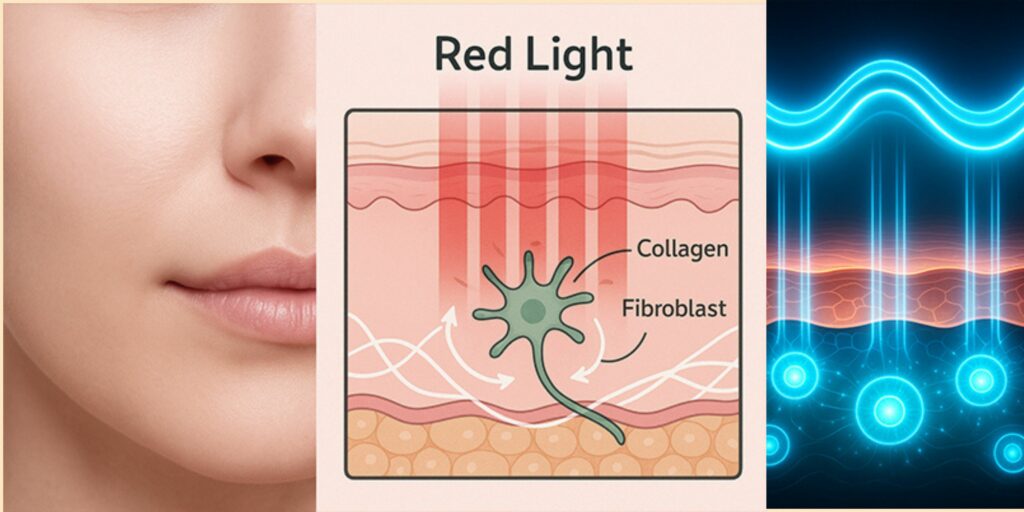
How specific wavelengths of red and near-infrared light stimulate collagen, reduce inflammation, and reverse visible signs of aging — without needles, downtime, or harsh chemicals
The global beauty industry spends billions annually on products that promise younger, brighter, firmer skin. Most of them work at the surface. Red light therapy goes deeper — literally. By penetrating several millimetres into the dermis and stimulating the mitochondria of skin cells, it activates the same repair mechanisms the body uses to heal itself. The results are measurable, the science is peer-reviewed, and the process involves nothing more than sitting in front of a panel of precisely calibrated light.
This guide covers what the research actually shows about red light therapy for skin, how to use it effectively, what results you can realistically expect, and how it compares to the alternatives — from professional facials to injectables.
Why Skin Ages — and What Red Light Therapy Does About It
Skin aging is not a single process but a cascade of interrelated cellular failures. From the age of 25, the body begins producing less collagen — the structural protein responsible for skin’s firmness and smoothness. By the mid-30s, production falls by roughly 1% per year, while existing collagen is simultaneously degraded by enzymes called matrix metalloproteinases (MMPs), activated by sun exposure, pollution, and chronic inflammation. The result is a gradual thinning of the dermal layer, the appearance of fine lines and wrinkles, loss of skin elasticity, uneven pigmentation, and a duller overall complexion.
What makes red light therapy scientifically interesting for skin aging is that it addresses the problem at its root: the fibroblast — the dermal cell responsible for producing collagen and elastin. When specific red wavelengths (630–660 nm) are absorbed by the mitochondria of these cells, they trigger a significant increase in ATP (cellular energy) production. This energy is the fuel the fibroblast needs to accelerate protein synthesis, repair damaged DNA, and regulate the inflammatory signals that accelerate cellular aging.
| The mechanism: Red light photons are absorbed by cytochrome c oxidase (Complex IV) in the mitochondria. This displaces nitric oxide that was suppressing cellular respiration, resulting in a measurable increase in ATP output, improved circulation via nitric oxide vasodilation, and a reduction in the oxidative stress that degrades collagen. |
What the Research Actually Shows
Red light therapy for skin is among the most studied applications of photobiomodulation. The evidence is not anecdotal — it comes from randomised controlled trials, systematic reviews, and meta-analyses published in peer-reviewed dermatology journals. Here is what the strongest studies found.
Collagen density and skin texture
A landmark controlled trial involving 113 participants used polychromatic LED light in the 611–650 nm range at approximately 9 J/cm², administered twice weekly over 30 sessions. Results showed significant increases in collagen density, visibly smoother skin texture, and measurable improvement in overall skin appearance compared to controls (PMC3926176).
A broader 2021 clinical analysis involving nearly 600 participants reported even more striking results after consistent red light exposure: 67% reduction in fine line visibility, a 58% improvement in skin firmness, a 45% increase in dermal moisture levels, and a 39% reduction in deep wrinkle depth.
Wrinkle reduction: the periocular study
One of the most rigorous recent trials was a 2023 split-face RCT involving 137 women using 660 nm red light at 3.8 J/cm² for 10 sessions over four weeks. The periocular region (around the eyes — where fine lines appear earliest) showed a 31.6% reduction in wrinkle volume in the red light-treated side vs. no change in the control side (PubMed: 36780572). This study is significant because it used objective volumetric measurement, not subjective self-reporting.
Wound healing and post-treatment recovery
A 2024 meta-analysis confirmed that red light therapy significantly accelerated wound closure times and reduced post-operative pain compared to standard care alone — a finding with direct relevance for skin treatments including microneedling, chemical peels, and laser resurfacing. Clinics that pair RLT with these procedures report faster epithelial recovery and reduced post-treatment redness.
Key clinical results at a glance
| 67%reduction in fine line visibility | 58%improvement in skin firmness | 45%increase in dermal hydration | 31.6%wrinkle volume reduction (periocular) |
What Red Light Therapy Treats: Skin Concerns Covered by Evidence
Fine lines and wrinkles
The evidence is strongest here. Red wavelengths (630–660 nm) stimulate fibroblast proliferation and type I collagen synthesis. Multiple RCTs confirm measurable improvement in wrinkle depth, skin smoothness, and dermal density after 8–12 weeks of consistent use. The effect is cumulative — results improve with continued treatment and are maintained with a reduced maintenance schedule (2–3 sessions per week).
Skin sagging and loss of firmness
Elastin — the protein that allows skin to spring back after stretching — degrades alongside collagen as we age. RLT stimulates the fibroblasts that produce both proteins simultaneously. Improvements in skin firmness and elasticity are typically measurable within 4–6 weeks of consistent treatment, with the most significant results appearing at the 8–12 week mark.
Acne and breakouts: the blue and red combination
For acne, the most effective protocol combines blue light (approximately 415 nm) with red light (630–660 nm). Blue light targets the p. acnes bacteria in the superficial epidermal layers. Red light penetrates deeper to reduce sebum overproduction and calm the inflammatory response around existing lesions. Research confirms that the combination is more effective than either wavelength used in isolation for achieving complete clearance. The ZenGlow GoldWave Mask combines both wavelengths in its Acne Removal mode alongside red and NIR for post-breakout healing.
Redness and rosacea
Red light therapy is one of the few evidence-backed non-laser options for rosacea. By strengthening the skin barrier, reducing inflammatory cytokine activity, and improving vascular tone through nitric oxide modulation, it addresses several of the physiological mechanisms behind persistent redness and flushing. Results are gradual and require consistency — typically 3–4 weeks before visible change.
Hyperpigmentation and uneven skin tone
RLT helps normalise melanin production in sun-damaged areas by regulating the activity of melanocytes. Yellow wavelengths (around 590 nm) are particularly effective for this application. One important note: individuals with darker skin tones (Fitzpatrick scales IV–VI) should approach skin-focused RLT carefully. Greater melanin concentration means more visible red light is absorbed at the surface, which can in some cases increase the risk of post-inflammatory hyperpigmentation. A conservative protocol — lower irradiance, shorter sessions, patch test first — is advisable.
Post-treatment recovery
One of the most clinically validated uses of RLT in aesthetic medicine is post-procedural recovery. After microneedling, chemical peels, laser resurfacing, or injectables, a 10–15 minute RLT session reduces inflammation, accelerates epithelial repair, and shortens visible downtime. Many aesthetic clinics now include it as a standard protocol step rather than an optional add-on.
| Skin Concern | Primary Mechanism | Evidence Strength |
| Fine lines & wrinkles | Collagen & elastin stimulation via fibroblast activation | Strong — multiple RCTs |
| Skin firmness & sagging | Elastin synthesis, dermal density improvement | Strong — measurable at 8+ weeks |
| Acne | Blue: antibacterial | Red: anti-inflammatory, sebum regulation | Strong — combination protocol |
| Redness & rosacea | Barrier support, vascular tone via NO signaling | Moderate — consistent in RCTs |
| Hyperpigmentation | Melanin normalisation, cellular regulation | Moderate — caution for darker skin tones |
| Post-procedure recovery | Accelerated wound closure, reduced inflammation | Very strong — meta-analysis confirmed |
How to Use Red Light Therapy for Skin: Protocol and Best Practices
Consistency is more important than session length. The most common failure in home RLT use is inconsistency — sporadic use delivers sporadic results. Here is the protocol evidence supports:
Session parameters
| Parameter | Recommended Approach |
| Distance from panel | 15–30 cm for face. Closer = higher irradiance but smaller coverage area. |
| Session length | 10–20 minutes for face. 15–30 minutes for body areas. |
| Frequency | 3–5 sessions per week for the first 8–12 weeks (loading phase), then 2–3x per week for maintenance. |
| Skin preparation | Clean, dry, makeup-free skin. No sunscreen, serums, or oils immediately before — these can absorb or reflect light. |
| Post-session | Apply serum or moisturiser immediately after — the improved circulation and open channels enhance absorption. |
| Eyes | Always wear protective goggles. Never look directly into a panel. The GoldWave Mask includes eye protection. |
Dosimetry: understanding the therapeutic window
Effective RLT operates within a specific energy dose range. Too little light delivers no benefit; too much can inhibit rather than stimulate. The optimal skin treatment window is generally cited as 3–50 J/cm² (joules per square centimetre). The formula is straightforward:
| Fluence (J/cm²) = Irradiance (mW/cm²) × Time in seconds ÷ 1,000Example: A panel at 50 mW/cm² run for 600 seconds (10 minutes) delivers 30 J/cm² — within the optimal range.At 100 mW/cm², 10 minutes = 60 J/cm² — approaching the upper limit for skin applications. |
This is why understanding your panel’s actual irradiance — not the manufacturer’s marketing figure — matters. Look for devices where irradiance is third-party verified at a defined distance.
Can you combine RLT with other skin treatments?
Yes — and in many cases you should. RLT works synergistically with a number of common skin treatments:
- After microneedling: Apply RLT within 24 hours to reduce inflammation and accelerate channel healing. Studies show faster epithelial closure and reduced post-treatment erythema.
- After chemical peels: RLT reduces surface inflammation and supports new cell turnover — shortening visible downtime.
- With hyaluronic acid serums: Apply immediately post-RLT session while circulation is elevated for enhanced absorption.
- With retinoids: Use on alternating days. Retinoids increase skin photosensitivity — check our section on medication interactions below.
Choosing the Right ZenGlow Device for Skin
Different formats serve different needs. Here is how to match the device to the treatment goal:
For targeted facial treatment
The ZenGlow GoldWave Mask (352 LEDs) is purpose-built for the face. Its 4 modes — Brightening, Tightening, Acne Removal, and Smoothing — each activate a specific wavelength combination optimised for that concern. The dedicated hairline zone also supports scalp circulation and follicle health. At 332g with a built-in 2,500 mAh battery, it is the most convenient hands-free option for daily facial treatment.
For face, neck, and upper body
The ZenGlow PRO 60 W7 or PRO 150 W7 panels cover a larger area than a mask and allow all seven wavelengths to be independently adjusted. This matters for skin: the 480 nm blue for surface antimicrobial action, 630 nm red for the dermis, and 660 nm deep red for cellular energy can be dialled in for the specific concern. For anti-aging, reduce blue and increase red and NIR. For acne, increase blue.
For full-body skin treatment (clinics and studios)
The ZenGlow PRO 600 W7 and PRO 1200 W7 deliver >200 mW/cm² irradiance with 221 cm full-body coverage. These are designed for professional settings where full-body skin treatment, post-procedure recovery, or multi-wavelength protocols are needed. The 30° beam angle preserves irradiance intensity over distance — important for maintaining therapeutic dose in a standing treatment position.
Safety, Side Effects, and Who Should Be Cautious
Red light therapy is non-ionising and does not carry the DNA-damaging risk of UV light. In clinical literature it is consistently described as safe for most skin types when used as directed. However, there are specific groups who should exercise caution or consult a dermatologist before starting.
Photosensitising medications
Some medications increase the skin’s sensitivity to light — not just UV, but visible red and NIR wavelengths. If you are taking any of the following, consult your prescribing doctor before beginning RLT:
| Medication Type | Examples | Risk Level |
| Antibiotics | Doxycycline, Tetracycline, Ciprofloxacin | High — especially Doxycycline |
| Retinoids | Isotretinoin (Accutane), Tretinoin | Moderate — increases dryness/irritation |
| Cardiac drugs | Amiodarone | Very high — up to 75% of users experience photosensitivity |
| Diuretics | Hydrochlorothiazide, Furosemide | Moderate |
| NSAIDs | Naproxen, Piroxicam | Low-moderate — possible stinging |
Darker skin tones
Individuals with Fitzpatrick skin types IV–VI have higher melanin density, which absorbs more visible red light at the surface. This can in some cases trigger post-inflammatory hyperpigmentation — darker patches that are more persistent than those caused by UV. The recommended approach is a conservative protocol: lower irradiance, shorter sessions (5–10 minutes initially), and a patch test on a small area of skin before committing to full facial treatment. Read more in our complete RLT guide.
Active skin conditions and contraindications
- Active herpes simplex or cold sores in the treatment area — RLT may trigger an outbreak
- Active cancer or suspicious lesions — consult an oncologist before use
- Pregnancy — limited data; conservative approach recommended for facial application
- Photosensitive skin conditions such as lupus or porphyria — avoid without medical clearance
Red Light Therapy vs. the Alternatives: An Honest Comparison
| Treatment | Invasive? | Downtime | Collagen stimulation | Ongoing cost | Safety |
| Red Light Therapy | No | None | Yes — fibroblast activation | Low (device) | High |
| Botox / Fillers | Yes (needle) | 2–7 days | No — muscle relaxant only | Very high | Moderate |
| Microneedling | Yes (micro) | 3–7 days | Yes — mechanical | High (clinic) | Moderate |
| Laser resurfacing | Yes | 7–14 days | Yes — ablative | Very high | Lower |
| Professional facials | No | None | Minimal | Medium (repeat) | High |
| Topical retinoids | No | Adjustment period | Yes — indirect | Low | High |
RLT is not a replacement for medical aesthetic procedures — it is a complement. Many dermatologists now pair RLT with microneedling or laser for faster recovery and enhanced results.
What to Realistically Expect (and When)
| Week 1–2: Skin may feel more hydrated. Subtle glow improvement is common. No dramatic visible change.Week 3–4: First visible changes in skin texture and tone begin to appear. Redness and acne inflammation typically shows early improvement.Week 6–8: Measurable improvement in fine lines and firmness. Collagen response becomes visible. Most RCTs begin showing statistically significant results at this point.Week 10–12: Peak of initial loading phase results. Skin texture, elasticity, and overall luminosity show the most significant improvement from baseline.Ongoing: Maintenance at 2–3 sessions per week preserves and builds on results. Collagen synthesis continues with consistent use. |
Frequently Asked Questions
How soon will I see results from red light therapy for skin?
Most people notice subtle improvements in skin hydration and glow within 1–2 weeks. Measurable changes in fine lines, firmness, and texture typically require 6–8 weeks of consistent use (3–5 sessions per week). Significant anti-aging results are most pronounced at the 10–12 week mark.
Can I use red light therapy every day?
Yes, within the biphasic dose guidelines. Daily sessions of 10–15 minutes are generally well tolerated and supported by research during the initial loading phase. The key is keeping total dose within the 3–50 J/cm² therapeutic window. Avoid doubling session length to compensate for skipped days.
Is red light therapy safe for sensitive skin?
Yes — it is one of the few skin treatments that is non-irritating and non-ablative. It does not remove tissue, generate heat at the surface, or trigger the inflammation response that many chemical exfoliants cause. It is safe for rosacea-prone and reactive skin types when used at appropriate irradiance levels.
Can I use RLT after botox or fillers?
Wait at least 48–72 hours post-injection before starting RLT sessions over the same area. The improved circulation from RLT can in theory affect the settling of hyaluronic acid fillers. After the initial period, RLT is generally considered compatible with filler maintenance.
Does red light therapy work for all skin types?
RLT is effective across all Fitzpatrick skin types. Those with darker skin tones (types IV–VI) should follow a more conservative protocol initially — shorter sessions, lower irradiance, patch test first — due to higher melanin absorption at the surface. See the full guide to using RLT safely.
Start Your Skin Journey with ZenGlow
Whether your focus is anti-aging, acne management, or simply maintaining healthy, radiant skin, ZenGlow’s range of red and near-infrared panels is designed to deliver clinical-grade photobiomodulation in a format that fits your life. From the portable GoldWave Mask for daily facial treatment to the full-body PRO 1200 W7 for professional settings, every device is built around the same principle: the right wavelengths, at the right dose, delivered consistently.
Explore the full range at zenglow.asia/shop, or read our complete guide to the benefits of red light therapy to go deeper into the science.