
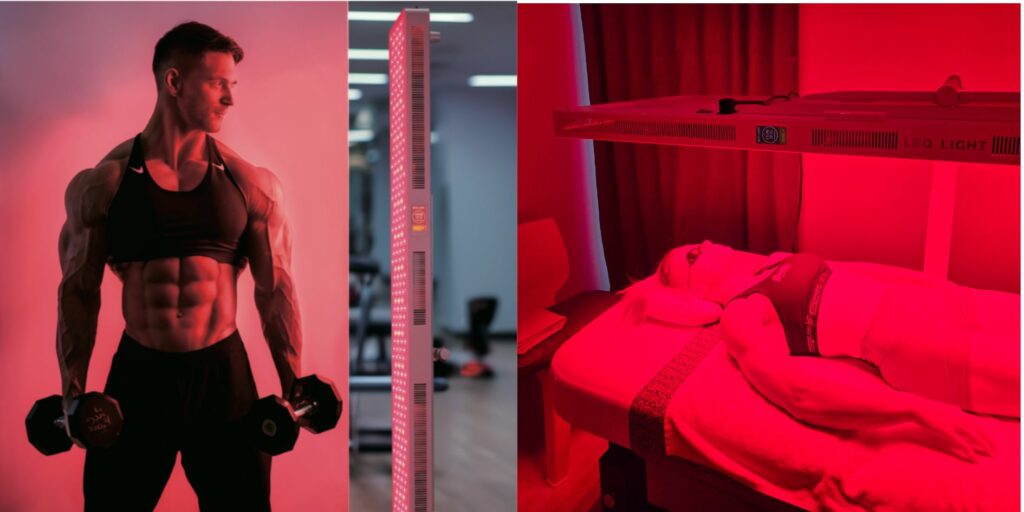
How photobiomodulation reduces muscle soreness, improves recovery time, enhances endurance, and fits into a serious training programme — with evidence-based protocols for before and after exercise
Recovery is training. Every serious athlete and coach understands this — but the tools available for managing recovery have historically been limited: cold water immersion, compression, nutrition, sleep, and massage. Red light therapy (photobiomodulation, or PBM) is now supported by enough peer-reviewed evidence to be considered a genuine addition to that toolkit.
This article covers what the research actually demonstrates about RLT for athletic recovery and performance, how to apply it correctly (timing, dose, and wavelength), which tissue types respond best, and how it fits alongside other recovery modalities. It is written for athletes, coaches, and sports medicine professionals who want the evidence rather than the marketing.
| 30–40%reduction in DOMS at 24–72 hrs post-exercise | 12%improvement in time-to-exhaustion (cyclists, RCT) | 5–15 minoptimal pre-workout application window | 0systemic side effects vs NSAIDs |
Why Athletic Recovery Is the Strongest Application for Red Light Therapy
Of all the clinical applications of photobiomodulation, the athletic recovery use case has some of the strongest and most consistent evidence. The reason is mechanistic: the biological effects of PBM map almost perfectly onto the physiological problems that intense exercise creates.
Intense training and competition produce a predictable cascade of cellular events:
- Micro-damage to muscle fibres — the controlled breakdown that drives adaptation, but that also causes soreness and limits subsequent training capacity
- Mitochondrial dysfunction — exercise-induced oxidative stress temporarily impairs the electron transport chain, reducing cellular energy output in the hours after training
- Inflammatory cytokine accumulation — IL-1beta, TNF-alpha, and prostaglandins accumulate in exercised tissue, driving DOMS and slowing repair
- Nitric oxide depletion — NO, which is critical for vasodilation and nutrient delivery, is consumed during intense exercise
Red light therapy addresses each of these directly. The photodissociation of inhibitory nitric oxide from cytochrome c oxidase (CCO) restores mitochondrial electron transport. The controlled ROS-driven activation of NF-kB downregulates inflammatory cytokines. The vasodilatory effect of released NO improves circulation to damaged tissue. And the ATP increase fuels the protein synthesis needed for fibre repair.
For the full explanation of these mechanisms, see our article: Red Light Therapy and the Mitochondria.
The DOMS Evidence: What the Research Actually Shows
The most consistent finding in the PBM sports science literature is a 30–40% reduction in delayed onset muscle soreness (DOMS) in the 24–72 hours following training when red light therapy is applied before or after exercise. This has been replicated across multiple independent research groups, different exercise modalities, and both laser and LED delivery systems.
How DOMS reduction works
DOMS is driven primarily by the inflammatory response to micro-damage in the muscle fibre and connective tissue. Prostaglandins, bradykinin, and substance P — released as part of the inflammatory cascade — sensitise nociceptors (pain receptors) in the muscle, producing the characteristic delayed-onset soreness that peaks 24–48 hours post-exercise.
PBM modulates this inflammatory cascade through two pathways. First, NF-kB activation upregulates anti-inflammatory cytokines and downregulates pro-inflammatory prostaglandins — the same target as NSAIDs, but through an endogenous pathway rather than pharmacological inhibition. Second, the nitric oxide vasodilation effect improves clearance of these inflammatory mediators from the tissue, reducing their dwell time. The net result is a reduction in inflammatory burden without impairing the adaptive stimulus — the muscle damage that drives hypertrophy and strength adaptation is preserved, but the painful inflammatory aftermath is reduced.
Specific trial findings
| Study / Population | Protocol | Key Outcome | Significance |
| Plyometric athletes (2022) | 630 nm + 940 nm NIR immediately post-exercise | Reduced muscle damage markers and soreness without blunting strength/power adaptation | Strong — preserved anabolic stimulus |
| CrossFit competitors | PBM at pre-, mid-, or post-workout time points | Lower creatine kinase (muscle damage marker) and inflammatory cytokines post-WOD | Strong — real-world training context |
| Meta-analysis (16 comparisons) | Laser and LED pre/post exercise across multiple sports | DOMS reduced in 13 of 16 comparisons; performance improved in majority | Very strong — consistent across sports |
| Resistance training (multiple RCTs) | NIR at 850 nm post-session to major muscle groups | 30–40% reduction in DOMS scores at 24–72 hrs vs. sham | Strong — matched controls |
| Critical point: the DOMS reduction effect does not blunt muscle adaptation. Multiple studies have specifically measured strength and hypertrophy outcomes alongside soreness and found that PBM reduces the painful inflammatory aftermath of training without reducing the anabolic stimulus. This is the key advantage over anti-inflammatory drugs (NSAIDs), which can impair muscle adaptation when taken regularly. |
Pre-Workout Application: Performance Enhancement, Not Just Recovery
While post-workout application gets most of the attention in the recovery context, pre-workout RLT application has its own distinct evidence base — and for some performance goals, the pre-workout protocol may be more valuable than the post-workout one.
The 5–15 minute pre-workout window
A landmark meta-analysis concluded that pre-exercise phototherapy consistently improved muscular performance and accelerated post-activity recovery across multiple sports modalities — with the optimal application window identified as 5–15 minutes before training. The mechanism: by reducing the NO inhibition of CCO before exercise begins, PBM allows mitochondria to operate at higher efficiency from the start of the session, delaying the onset of fatigue and improving energy substrate utilisation.
Endurance: the cyclist RCT
A double-blind, randomised crossover trial with competitive cyclists averaging 460 km of training per week found that pre-exercise PBM improved oxygen uptake kinetics and delayed time-to-exhaustion by approximately 12% during successive sprint efforts. In endurance sports where performance margins are small, a 12% improvement in time-to-exhaustion represents a meaningful competitive edge.
Strength and power
For resistance training and power sports, pre-workout PBM has been linked to small but statistically significant improvements in peak torque, jump height, and total work output in controlled trials. The mechanism is the same: improved mitochondrial efficiency from the start of the session, with the added benefit of improved local circulation (via NO vasodilation) in the treated muscle groups.
Pre-workout dose: why less is more
Pre-workout application requires a lower dose than post-workout recovery. The goal is mitochondrial priming, not repair — and the biphasic dose response means that overdosing before exercise can actually inhibit rather than enhance performance. The optimal pre-workout fluence is 4–6 J/cm² per muscle group, achieved with a moderate-irradiance panel at 5–10 minutes per target area. Higher doses (>15 J/cm²) in the pre-workout window have not shown additional performance benefits and may in some studies produce slight impairment.
Evidence-Based Protocol: How to Actually Use RLT in Training
The correct protocol depends on whether you are using RLT before or after exercise, and which tissue type you are targeting. Here is the evidence-based framework:
Pre-workout protocol
| Timing | Wavelengths | Target | Dose | Session |
| 5–15 min before training | 660 nm + 810 nm NIR | Primary working muscle groups for the session | 4–6 J/cm² per group | 5–10 min per area |
Post-workout recovery protocol
| Timing | Wavelengths | Target | Dose | Session |
| Within 30–60 min post-exercise | 630 nm + 850 nm NIR | All trained muscle groups + major joints | 10–20 J/cm² total | 10–15 min per area |
Tissue-specific protocols
| Tissue Type | Optimal Wavelengths | Clinical Recommendation | Notes |
| Muscle injury | 660–680 nm + 800–850 nm | Daily for 1–2 weeks, then taper to 2–3x per week | NIR penetrates to deep quads, glutes, hamstrings |
| Ligament / tendon | 630–680 nm + 780–860 nm | 3 sessions per week for 4–6 weeks; 12–18 sessions total | Tendons have poor blood supply — consistent use is critical |
| Large muscle groups | 850 nm NIR emphasis | Apply within 30 min post-workout for maximum DOMS reduction | 850 nm preferred over 630 nm for deep tissue penetration |
| Joints (knee, shoulder, hip) | 810–850 nm NIR | 3x per week ongoing for chronic joint conditions | Combine with appropriate physiotherapy |
Distance and coverage
Panel distance matters for dose delivery. At 10–15 cm from skin, a ZenGlow PRO W7 panel delivers >100 mW/cm². At 30 cm, irradiance drops — but the 30° beam optics of the W7 series preserve irradiance over distance better than standard 60° panels. For large muscle groups (quads, hamstrings, back), maintain 15–20 cm distance and cover each major group for the full protocol duration. For joints and tendons, closer application (10–15 cm) is appropriate due to the need for deeper penetration.
Frequency: how often is optimal?
For active athletes in a regular training cycle: 3–5 sessions per week is supported by the evidence for recovery applications. Daily use is not contraindicated and may be appropriate during periods of high training load or injury recovery. The key constraint is not frequency but total dose per session — staying within the 3–50 J/cm² therapeutic window is more important than limiting sessions per week.
Injury Recovery: Beyond DOMS to Genuine Tissue Repair
For athletes managing injuries — whether acute muscle strains, chronic tendinopathy, or post-surgical rehabilitation — the evidence for PBM extends well beyond DOMS reduction into genuine tissue repair mechanisms.
Tendon and ligament repair
Tendon injuries are among the most frustrating for athletes because tendons have poor blood supply and slow metabolic turnover. PBM addresses this directly: the vasodilation effect of released NO improves local circulation in an otherwise poorly-perfused tissue, while the ATP increase fuels the tenocyte activity required for collagen fibre synthesis and remodelling. Literature reviews of PBM for conditions including knee osteoarthritis, Achilles tendinopathy, and rotator cuff injuries report significant improvements in pain and functional scores compared to sham treatment, typically over 4–6 week protocols of 3 sessions per week.
Post-surgical rehabilitation
A 2024 meta-analysis confirmed that PBM significantly accelerated wound closure times and reduced post-operative pain compared to standard care alone — findings that translate directly to post-surgical sports rehabilitation. Athletes recovering from ACL reconstruction, rotator cuff repair, or meniscal surgery may benefit from PBM applied to the surgical site (once cleared by the treating surgeon) as part of a structured rehabilitation protocol.
The concern about blunting adaptation
A frequently asked question in sports science circles is whether PBM — by reducing post-exercise inflammation — might also reduce the adaptive stimulus for muscle growth. The evidence is reassuring: multiple RCTs that measured both soreness and hypertrophy outcomes have found no impairment of muscle adaptation alongside DOMS reduction. This distinguishes PBM from regular NSAID use, where evidence suggests that frequent anti-inflammatory drug use can impair satellite cell activation and long-term muscle hypertrophy. PBM appears to modulate the inflammatory cascade in a more targeted way — reducing the painful, unproductive overflow of the inflammatory response while preserving the anabolic signalling.
Contrast Therapy: Combining RLT with Cold Plunge and Sauna for Maximum Recovery
For athletes seeking the most comprehensive recovery protocol, the evidence increasingly supports a multi-modality contrast therapy approach that combines red light therapy, infrared sauna, and cold water immersion in sequence. Each modality addresses a different aspect of post-exercise physiology:
| The Athlete Recovery Circuit — recommended sequence: 1. Red Light Therapy (10–15 min): Activates CCO, increases ATP, initiates anti-inflammatory NF-kB signaling, improves local circulation via NO vasodilation. Apply to the primary trained muscle groups. 2. Infrared Sauna (20–30 min): Heat stress activates heat shock proteins, increases core circulation, drives metabolite clearance via sweating. The ZenGlow FIR sauna range operates at 40–65°C for full-body thermal benefit. 3. Cold Plunge (2–5 min at 10–15°C): Vasoconstriction drives the ‘rebound’ circulation response, reduces acute inflammation, and produces the alertness reset associated with cold water immersion. The ZenCold Lanta delivers consistent 3°C minimum temperature. This sequence is used at Life Balance Phuket — ZenGlow’s own wellness studio — and is the protocol we recommend to commercial operators building multi-modality recovery facilities. |
For the full science behind this comparison, see: Red Light Therapy vs. Infrared Sauna: What’s the Actual Difference?
Choosing the Right Device for Athletic Use
Device selection for athletic recovery should be driven by the muscle groups you are primarily targeting and the format that fits your training routine:
| Use Case | ZenGlow Device | Why |
| Targeted recovery — single muscle group (e.g. quads, shoulders) | 7 wavelengths including 810 nm and 850 nm NIR for deep muscle penetration. 30° beam optics preserve irradiance over distance. | |
| Full lower-body or torso recovery | Half-body coverage per session. Covers quads + hamstrings or back + glutes in a single 15-min session. | |
| Full-body post-workout recovery — gym or studio | 221 cm coverage, >200 mW/cm² irradiance. Covers the full body front or back in a single standing session. | |
| Professional recovery facility — clinical throughput | Full-body simultaneous exposure. PRO 1200 W7: dual panel for front and back. Oyster PRO: 41,600 LEDs, 6,500W, 360° in one session. | |
| Post-tattoo, joint, or localised injury recovery | Flexible wrap design for targeted joint and localised tissue treatment. Ideal for knee, shoulder, ankle rehab protocols. |
For guidance on verifying irradiance specifications and what to look for in a performance-grade device, read our Buyer’s Guide to Red Light Therapy Devices.
Frequently Asked Questions
Should I use red light therapy before or after a workout?
Both timing strategies are evidence-supported but serve different purposes. Pre-workout (5–15 min before): primes mitochondrial function, improves endurance, and may enhance strength output during the session. Post-workout (within 30–60 min): reduces DOMS, accelerates tissue repair, and clears inflammatory metabolites. If your primary goal is performance, prioritise pre-workout. If your primary goal is recovery, prioritise post-workout. If time allows, both can be used in the same day.
Does red light therapy work for tendon and ligament injuries?
Yes, and the evidence is particularly valuable here because tendon healing is typically slow due to poor blood supply. PBM’s vasodilation effect directly addresses this limitation. The recommended protocol for tendon conditions is 3 sessions per week for 4–6 weeks, with NIR wavelengths (810–850 nm) applied at 10–15 cm. Improvement in pain and function is typically measurable within 3–4 weeks, with maximum benefit at the 6–8 week mark.
Can red light therapy help with chronic joint pain from sport?
Literature reviews of PBM for osteoarthritis — the most common chronic joint condition in athletes — report significant improvements in pain and disability scores. The mechanism is the combination of anti-inflammatory NF-kB signaling and improved joint perfusion via NO vasodilation. Maintenance treatments (2–3 sessions per week ongoing) are typically required to prevent return of symptoms as the underlying joint degeneration is not reversed. See also: Red Light Therapy for Pain and Inflammation
Will using RLT every day have any negative effects?
Daily use is generally safe provided each session stays within the therapeutic dose window (3–50 J/cm²). The risk of daily use is not toxicity but over-stimulation — exceeding the biphasic dose threshold (>60–100 J/cm²) per session, which can inhibit rather than promote healing. At standard professional panel irradiances (50–100 mW/cm²), 10–15 minutes per area per day is within safe parameters. Avoid doubling session length to compensate for a missed day.
Can I use red light therapy during competition season?
Yes. RLT has no banned substance implications, no pharmacological effects, and no recovery period. Several professional sports teams and elite athletes use it daily during competition season for its recovery and anti-inflammatory benefits. There is no evidence of performance impairment or interference with training adaptation.
Set Up Your Athletic Recovery Protocol with ZenGlow
Whether you are an individual athlete optimising your home recovery setup, a gym building a premium recovery zone, or a sports medicine facility equipping a clinical treatment room, ZenGlow provides professional-grade panels with the wavelength range, irradiance verification, and commercial support that athletic applications require.
Explore the full range at zenglow.asia/shop, read about building a recovery facility with RLT, sauna, and cold plunge, or check out the science behind the technology at our Red Light Therapy Science page.